Pre-production
Mahua Butter — editorial still life
Dossier N° 06 · Central India · Madhya Pradesh

Mahua Butter

Madhuca longifolia

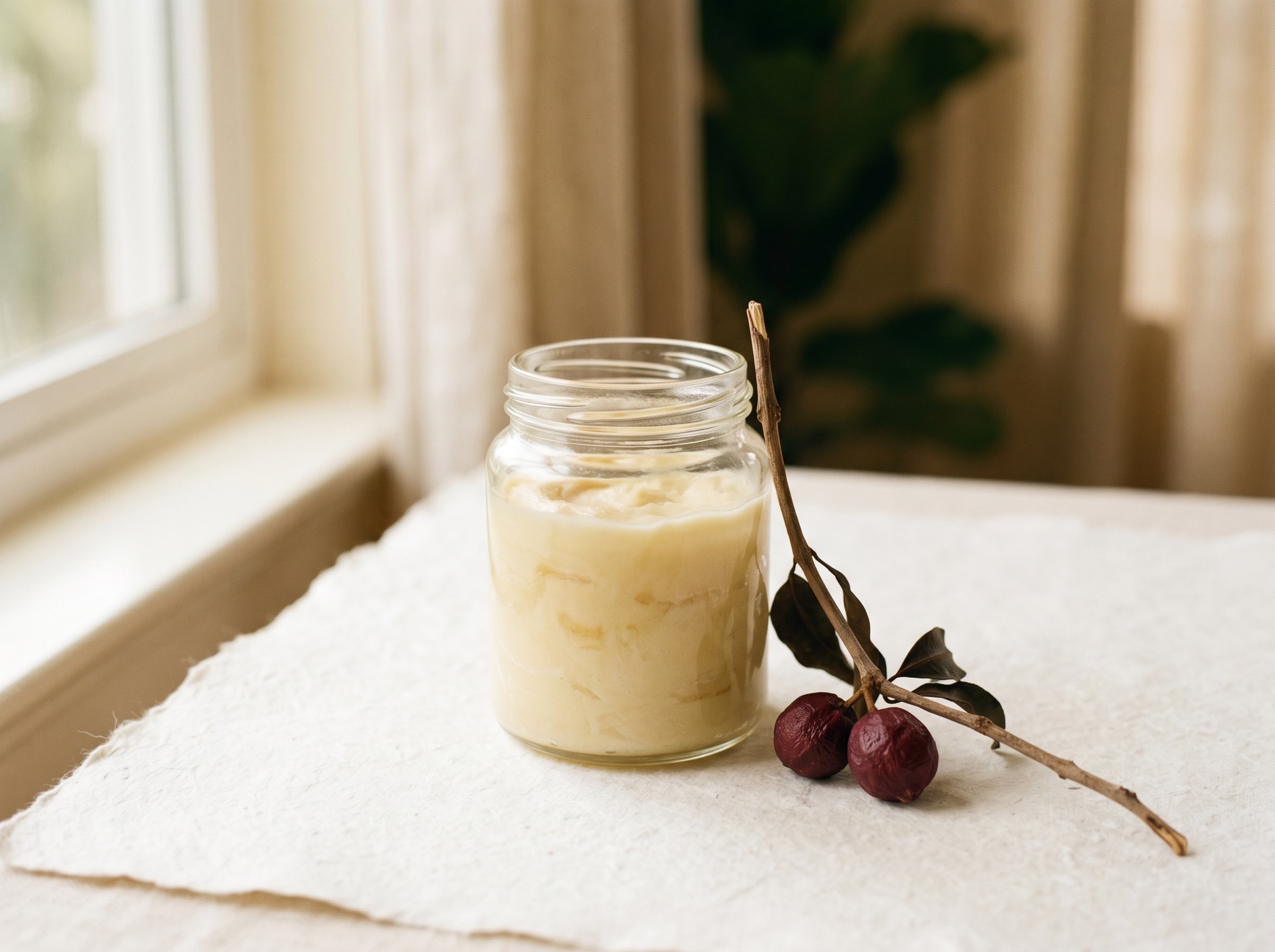
Pressed from the seed of India's oldest cosmetic tree — a species that has fed and oiled forest communities across the Deccan for centuries. The butter is softer than kokum or sal, with a balanced stearic–oleic profile and a gentle, faintly sweet aroma. It carries the quiet authority of an ingredient that has simply always been used.

N° 01
The forest & the seed

What this lipid actually is.

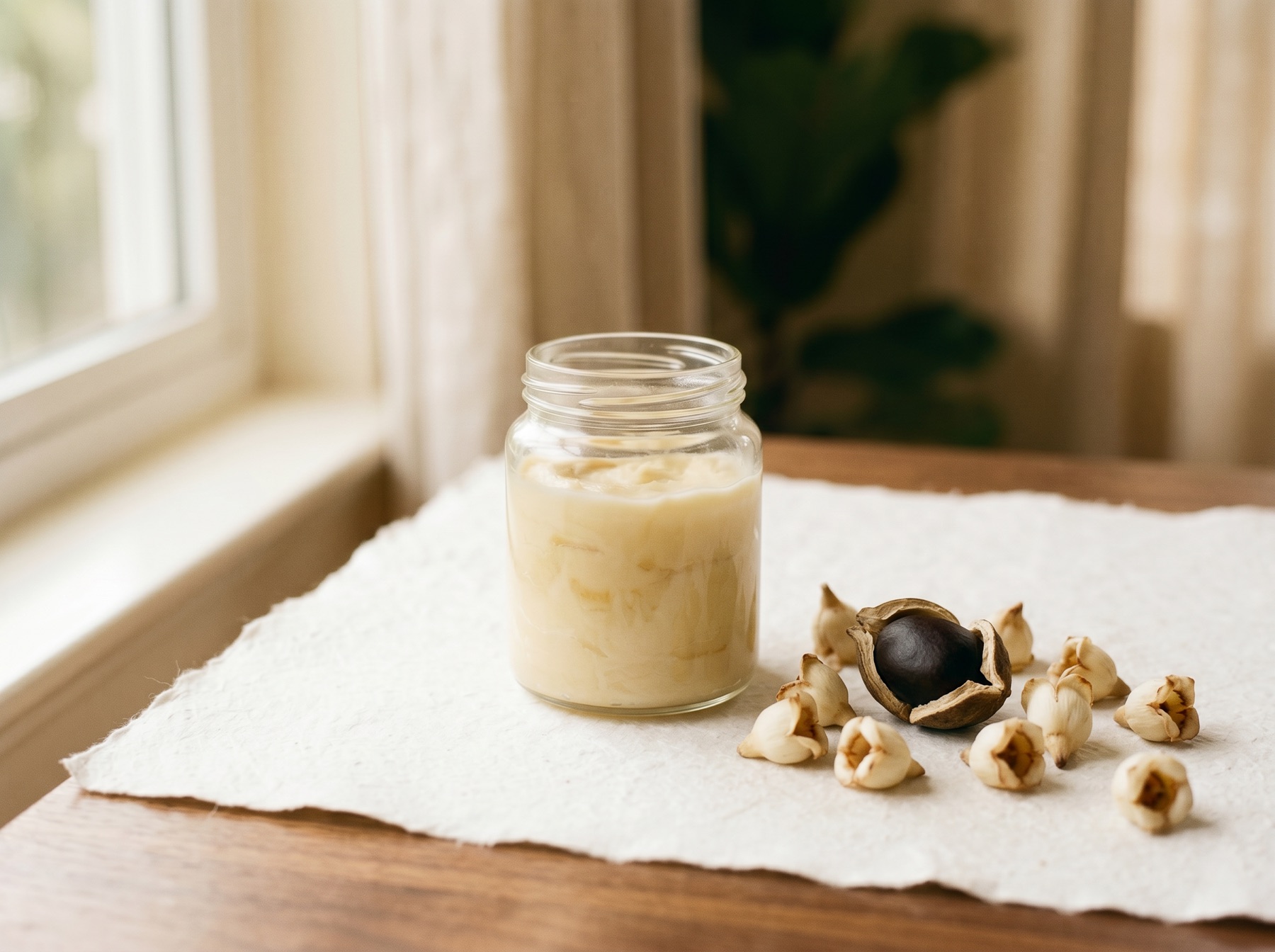
Mahua is the heritage lipid of India. The tree flowers in late summer, drops its golden corolla onto the forest floor, and yields a seed whose oil has been a staple of tribal kitchens, cosmetic practice, and Ayurvedic medicine for longer than any written record survives. The sourcing intent is named co-operatives across the Mandla and Dindori districts of Madhya Pradesh — communities for whom the mahua tree is not a crop but a relative.

The butter itself is chemically distinct from the Konkan set. Palmitic acid sits at 15 to 18 percent, unusually high for a natural butter, giving the lipid a softer melt and a more emollient feel. Stearic acid lands between 25 and 35 percent. Oleic climbs to 37 to 46 percent. The result is a butter that melts across a wide range — 28 to 35°C — rather than snapping at a single temperature.

Formulators reach for mahua when they want body without structure, and skin-feel without tack. It slots naturally into soaps, massage bases, low-cost body creams, and traditional Ayurvedic salves. For industrial users it lends itself to candle wax blends, leather conditioners, and bio-lubricants — a legitimate second market that helps us offer fair prices to the forest co-operatives.

The lipid India has always used. Our aim is simply to ship it cleaner.
N° 02
Specifications

The numbers behind every kilogram.

Technical specifications

Published typical values · not lot data

Melt point
28–35 °C
SAP value
187–196 mg KOH/g
Iodine value
58–70
Stearic acid
25–35 %
Oleic acid
37–46 %
Shelf life
18 months
MOQ (target)
100 kg

Fatty acid signature

Fatty acidNotationTypical range
OleicC18:137–46%
StearicC18:025–35%
PalmiticC16:015–18%
LinoleicC18:212–17%
Other<5%
N° 03
Formulation uses

Where it earns its keep.

Applications where this lipid is generally used, drawn from published formulation practice.

Cold-process soaps

Balanced hardness and lather. A workhorse saponified lipid.

Ayurvedic massage bases

Traditional carrier; warms on skin; tolerates essential oil loading.

Low-cost body creams

Cost-effective emollient at 5 to 12 percent inclusion.

Candle and wax blends

Industrial grade extends soy wax without paraffin.

Leather and textile dressings

Heritage application; conditioning without residue.

Toll refining for private label

We refine to cosmetic grade for contract manufacturers.

Substitution guidance

Mahua substitutes shea at 1:1 in soap formulas for lower cost and faster cure. In creams, pair with 10 to 15 percent kokum or mango stearin to restore body. Not a direct replacement for cocoa butter — the polymorphism is wrong for confectionery.

Provenance of these figures

Every specification on this page is a published typical value for the botanical species, compiled from supplier technical data sheets and the peer-reviewed literature. Real ranges shift with origin, season, kernel quality and refining route: treat these as indicative, and always specify against your supplier’s own CoA.

Pre-production

First samples go to this list.

Register interest and we will write to you personally when there is validated pilot material.

Register interest
N° 04
Also from the shelf

Three more dossiers.

The heritage lipid of the Deccan forest.

From Konkan with love.